
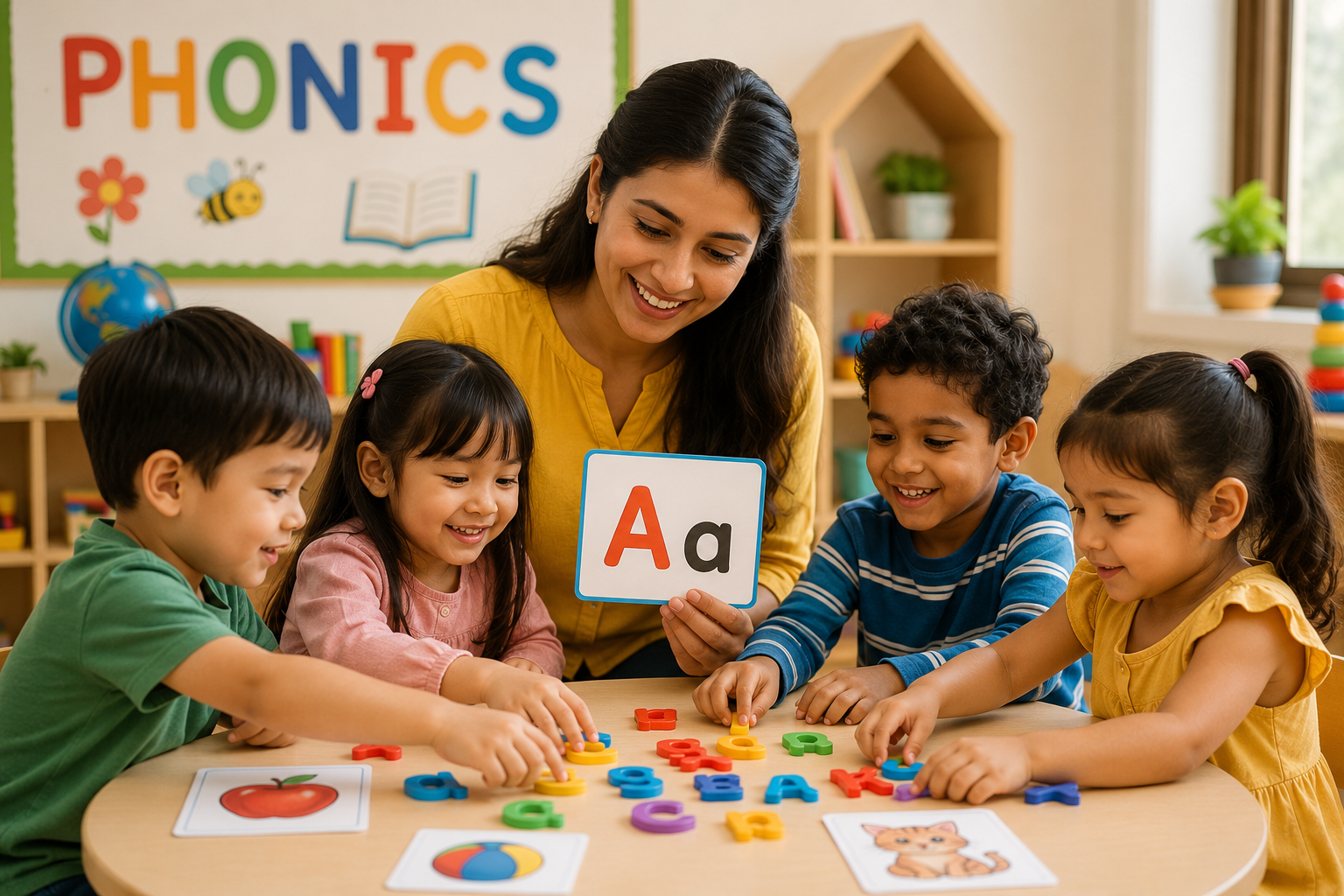
Recognising letters, understanding sounds, and reading simple words create the foundation for future academic success. One of the most effective ways to develop these skills is through phonics.
Modern preschools across India are increasingly adopting phonics as a core part of their kindergarten learning program because it helps children learn naturally through sounds rather than memorisation.
In this guide, we’ll explore what phonics is, why it matters, its benefits, classroom activities, and how parents and teachers can support children’s literacy journey.
What Is Phonics?
Phonics is a method of teaching reading by connecting letters (graphemes) with their sounds (phonemes).
Instead of asking children to memorise whole words, phonics teaches them how to decode words by blending sounds together.
For example:
- c + a + t = cat
- d + o + g = dog
- s + u + n = sun
This approach gives children the confidence to read unfamiliar words on their own.
Why Is Phonics Important in Preschool?
The preschool years are the ideal time to introduce phonics because children’s brains are highly receptive to language development.
Phonics helps children:
- Recognize letter sounds
- Blend sounds into words
- Improve pronunciation
- Build vocabulary
- Develop reading confidence
- Prepare for formal schooling
When introduced through songs, games, and storytelling, phonics becomes enjoyable rather than overwhelming.
10 Benefits of Phonics in Preschool Education
1. Builds Strong Reading Skills
Phonics teaches children how to decode words independently.
Instead of guessing words from pictures, children understand how letters work together to create sounds, making reading easier and more accurate.
2. Improves Pronunciation
Learning correct letter sounds helps children pronounce words more clearly.
This is especially beneficial for multilingual learners who are developing English language skills alongside their home language.
3. Develops Vocabulary
As children learn more sounds, they can read more words.
Reading regularly exposes them to new vocabulary, helping them express themselves with greater confidence.
4. Boosts Writing Skills
Phonics supports early writing by helping children hear and identify sounds in words.
Children begin writing simple words such as:
- Cat
- Ball
- Fish
- Sun
- Tree
This strengthens both spelling and sentence formation over time.
5. Enhances Listening Skills
Children learn to identify individual sounds, blend them together, and distinguish similar words.
Activities like rhyming games, sound matching, and listening exercises improve concentration and auditory discrimination.
6. Encourages Independent Learning
Children who understand phonics rely less on memorization.
They become more confident in attempting new words, fostering independence and a positive attitude toward learning.
7. Strengthens Memory
Repeating letter sounds through songs, games, and storytelling helps children retain information more effectively.
Consistent practice reinforces long-term memory and language development.
8. Makes Learning Fun
Phonics can be introduced through engaging activities such as:
- Alphabet songs
- Flashcards
- Sound hunts
- Puppet shows
- Picture matching
- Interactive games
- Storybooks
Play-based learning keeps children motivated and excited.
9. Prepares Children for School
Children with a strong phonics foundation enter primary school ready to:
- Read simple books
- Follow classroom instructions
- Write basic words
- Participate confidently in literacy activities
This smooth transition builds self-esteem and academic readiness.
10. Builds Lifelong Confidence
Success in reading encourages curiosity and a love for learning.
Children who experience early literacy success are more likely to enjoy books, explore new ideas, and become lifelong learners.
Fun Phonics Activities for Preschoolers
Parents and teachers can introduce phonics through enjoyable, hands-on experiences.
Alphabet Treasure Hunt
Hide alphabet cards around the classroom or home.
Children search for letters and say the corresponding sounds.
Sound Sorting
Provide picture cards and ask children to group them by beginning sound.
Example:
- Ball
- Banana
- Butterfly
All begin with the /b/ sound.
Rhyming Games
Encourage children to identify rhyming words such as:
- Cat – Hat
- Sun – Fun
- Pig – Wig
Rhyming strengthens sound awareness.
Story Time with Sound Focus
While reading, pause and ask:
“What sound does this word begin with?”
Children become active participants instead of passive listeners.
Letter Formation Activities
Use:
- Sand trays
- Clay
- Finger painting
- Air writing
These activities strengthen fine motor skills while reinforcing letter recognition.
The Role of Teachers
Teachers play a crucial role in making phonics meaningful.
Effective educators:
- Model correct pronunciation
- Use interactive teaching methods
- Encourage participation
- Provide positive reinforcement
- Adapt activities to different learning styles
Regular teacher training ensures phonics instruction remains engaging and effective.
How Parents Can Support Phonics at Home
Parents can reinforce classroom learning through simple daily activities.
Ideas include:
- Reading storybooks together
- Singing alphabet songs
- Practicing letter sounds during play
- Labeling household objects
- Playing word games
- Encouraging conversations
- Celebrating reading progress
Just 15–20 minutes of daily reading practice can make a significant difference.
Common Myths About Phonics
Myth: Phonics is only about memorizing sounds.
Reality: Phonics teaches children how sounds combine to form words, encouraging understanding rather than memorization.
Myth: Phonics is difficult for preschoolers.
Reality: When taught through songs, games, and stories, phonics is enjoyable and developmentally appropriate.
Myth: Children can learn to read without phonics.
Reality: While some children memorize words, phonics equips them with the skills to decode unfamiliar words independently.
Choosing a Preschool with a Strong Phonics Program
When selecting a preschool, look for:
- Structured phonics lessons
- Qualified and trained teachers
- Interactive classroom activities
- Age-appropriate learning materials
- Reading-rich environments
- Regular parent communication
- Assessment of literacy progress
A balanced approach that combines phonics with storytelling, play, and creative learning supports holistic development.
Conclusion
Phonics is much more than learning letter sounds—it’s the gateway to confident reading, effective communication, and lifelong learning.
By introducing phonics during the preschool years through engaging, activity-based methods, children develop the literacy skills they need for future academic success. Combined with storytelling, creative play, and supportive teaching, phonics helps young learners become curious, confident readers.
Parents and educators who invest in early phonics education are giving children a powerful foundation for school and beyond.
Frequently Asked Questions (FAQs)
1. What is phonics in preschool education?
Phonics is a teaching method that helps children learn the relationship between letters and their sounds, making it easier to read and write.
2. At what age should children start learning phonics?
Most children can begin learning phonics between the ages of 3 and 5 through playful, age-appropriate activities.
3. Why is phonics better than memorizing words?
Phonics teaches children how to decode new words independently rather than relying on memorization, leading to stronger reading skills.
4. Can parents teach phonics at home?
Yes. Reading together, singing alphabet songs, practicing letter sounds, and playing word games are excellent ways to reinforce phonics at home.
5. How does phonics fit into a kindergarten learning program?
Phonics forms the foundation of early literacy by supporting reading, writing, pronunciation, vocabulary development, and overall language skills.
About Smart Kindergarten
At Smart Kindergarten, we believe every child deserves a strong start in literacy. Our preschool curriculum integrates systematic phonics instruction with activity-based learning, storytelling, digital classroom resources, and teacher training to create engaging learning experiences. By combining play, creativity, and structured literacy, we help children become confident readers and lifelong learners while supporting schools with comprehensive educational solutions.
